☎︎ +1 760 585 9393
The $2T Cognitive Capital Opportunity

TL;DR / Executive Summary
- The Shift: As AI automates routine tasks, human cognitive performance (critical thinking, adaptability, and judgment) is becoming an organization’s ultimate competitive differentiator. We are entering the Brain Economy.
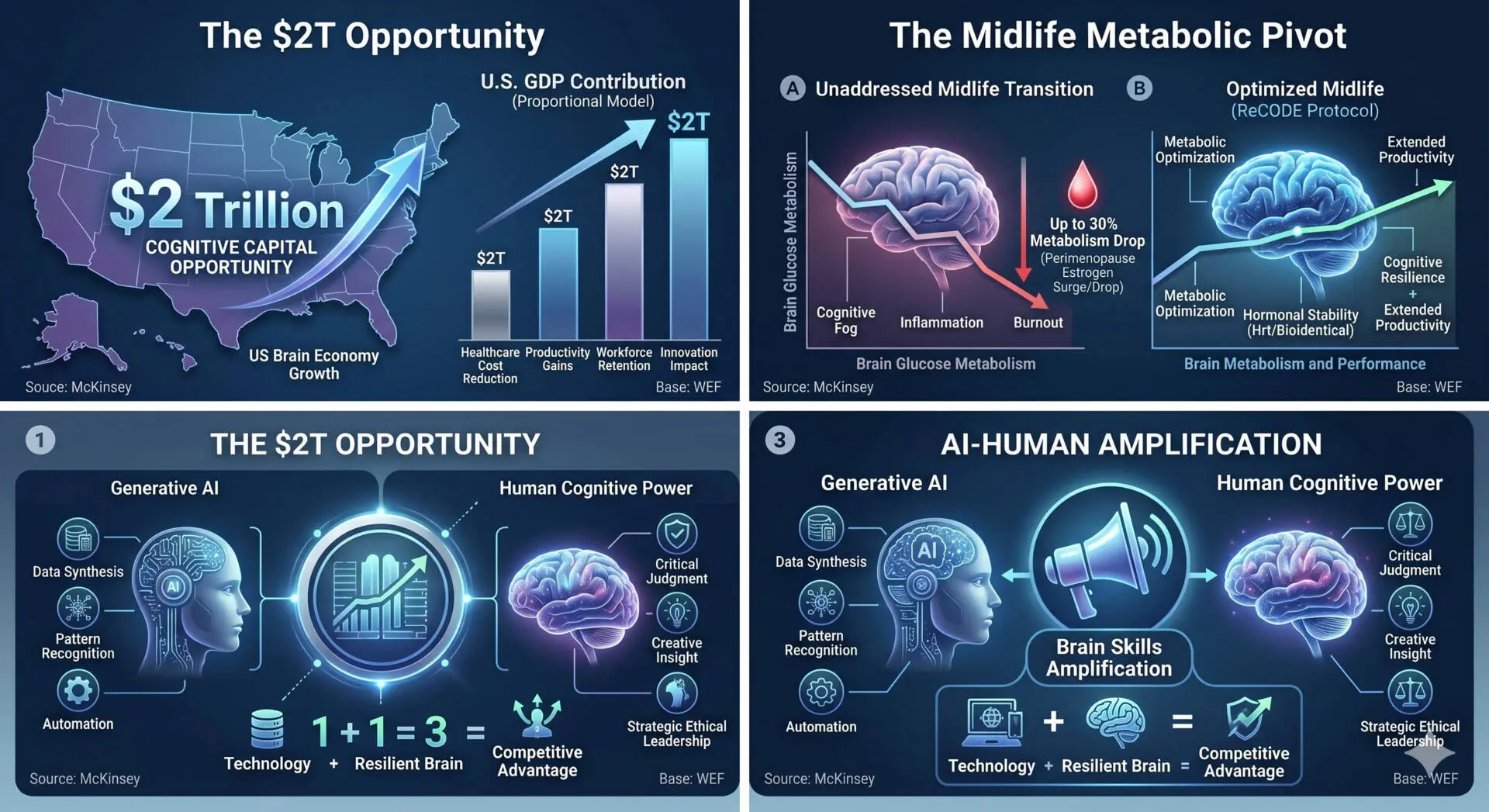
- The Crisis: Millions of high-performing leaders are hitting midlife precisely when cognitive demands peak, while simultaneously battling hidden biological headwinds—like perimenopause, which can drop brain glucose metabolism by up to 30%.
- The Opportunity: Proportional economic models reveal a $2 trillion cognitive capital opportunity in the U.S. By leveraging advanced midlife frameworks like the ReCODE Protocol, forward-thinking organizations can mitigate burnout, extend executive longevity, and protect their most valuable balance-sheet asset.
For decades, economists have measured national wealth through physical infrastructure, corporate tax rates, technological pipelines, and financial capital. But a groundbreaking data framework from the McKinsey Health Institute and the World Economic Forum suggests we have been overlooking our most valuable macroeconomic asset: the human brain.
As artificial intelligence rapidly handles transactional and repetitive work, the primary limiting factor for business growth is no longer access to data. Data is abundant. The true differentiator is now an organization’s collective capacity to think clearly, learn quickly, make complex decisions, regulate stress, and navigate profound ambiguity.
We are witnessing the emergence of the Brain Economy. And as an ex-Wall Street VP turned functional medicine clinician, I view this shift through a very specific lens: Human cognition is no longer just a healthcare concern. It is your company’s ultimate balance-sheet asset.
What Is Cognitive Capital?
The McKinsey Health Institute defines “Brain Capital” as a dual-engine asset consisting of two distinct parts:
- Brain Health: Your physiological baseline—including optimal neuro-metabolism, cognitive resilience, emotional well-being, and active protection from burnout or neurodegenerative disease.
- Brain Skills: Your executive execution—including critical thinking, creative problem-solving, strategic adaptability, and learning agility.
Historically, these traits were viewed as personal attributes. If you were focused and sharp, it was a personal win; if you were burning out, it was a personal problem.
Today, they are core corporate assets. Just as a company invests heavily in software, manufacturing hardware, and intellectual property, modern leadership must begin investing in the physiological capacity of their workforce. In a knowledge-driven market, the brain is the production engine. If the engine is starved of fuel, the entire enterprise stalls.
Why AI Makes Human Cognition More Valuable, Not Less
There is a common misconception that the rise of AI will reduce the need for high-level human brain performance. In reality, the exact opposite is true.
AI can synthesize information, but it cannot determine what information truly matters. It can process trillions of data points, but it cannot provide context or executive judgment. As technology automates transactional tasks, the premium on uniquely human cognitive abilities has skyrocketed.
The future competitive advantage does not belong to the organization with the most expensive software. It belongs to the organization with the most resilient, high-functioning brains.
America’s Hidden Cognitive Crisis
While corporations pour billions into digital transformation, they are largely ignoring a quiet, unhedged threat to their primary infrastructure. Across the modern workforce, rates of chronic stress, severe burnout, sleep deprivation, and cognitive overload are at an all-time high.
Compounding this crisis is a massive demographic shift. The workforce is aging, and millions of high-performing executives are hitting midlife precisely when cognitive demands at work are peaking.
Every day in my practice, I see brilliant, capable professionals attempting to lead complex organizations while silently battling a storm of biological headwinds:
- Perimenopause and sudden estrogen drops that alter brain glucose metabolism by up to 30%
- Chronic systemic inflammation and metabolic dysfunction
- Severe sleep architecture disruption
- The overwhelming emotional load of caregiving responsibilities
The result is a widening mismatch between what the modern economy demands from our brains and how we structurally support the biology required to deliver it.
The Midlife Opportunity: Shifting the Paradigm
The greatest untapped lever for building cognitive capital lies in midlife optimization. The physiological drivers of long-term cognitive decline—including localized neuro-inflammation, insulin resistance in the brain, and precipitous hormonal drops—emerge in the body decades before severe clinical symptoms ever appear.
The encouraging clinical reality is that these variables are completely modifiable.
This is why advanced frameworks like the ReCODE Protocol (Reversing Cognitive Decline) are so revolutionary for executive longevity. Rather than waiting for cognitive deficits to become irreversible, the ReCODE approach identifies an individual’s specific metabolic, inflammatory, and toxic blind spots early. By aggressively optimizing these drivers in midlife, we can systematically prevent and even reverse early-stage cognitive vulnerabilities.
The future of business leadership is not about managing a chronic disease once it develops. It is about using precision protocols like ReCODE to preserve and optimize cognitive capacity decades before a crisis hits.
The $2 Trillion Bottom Line
The financial implications of bridging this gap are staggering. McKinsey estimates that scaling evidence-based brain health interventions globally could generate up to $6.2 trillion in cumulative GDP gains by 2050, anchoring a wider $26 trillion global opportunity.
When we apply these projections proportionally to the United States, the American cognitive capital opportunity sits at a conservative $2 trillion*.
This value won’t come from a single breakthrough pharmaceutical drug. It will come from fundamentally optimizing the day-to-day brain performance of millions of working professionals. When you multiply marginal biological improvements across a high-value population, the compounding macro returns are undeniable:
- Sharper executive decision-making under intense market pressure
- Fewer high-value leaders operating in catastrophic burnout
- Delayed onset of cognitive decline and dementia
- Substantially lower rates of clinical depression and anxiety
- Extended, highly productive, long-term careers
The Next Great Capital Investment
The Industrial Revolution was powered by mechanical engines. The Digital Revolution was powered by microchips. The AI Revolution will be powered by human brains.
Technology will continue to accelerate exponentially, but the organizations, leaders, and societies that thrive will be those that honor a fundamental biological truth: human cognition is an economic asset. In fact, it is the most undervalued asset in America today.
The question for forward-thinking organizations is no longer whether you can afford to invest in the brain health of your leadership. The question is: Can your business afford the cost of an unoptimized mind?
Take Action: Protect Your Organization’s Cognitive Capital
If you are a CEO, founder, or HR executive, you are likely already auditing your technology pipelines and financial risks for the upcoming fiscal year. But have you audited your company’s primary infrastructure—the collective brain health of your leadership team?
Unaddressed midlife health shifts, chronic burnout, and cognitive decline are not just personal health issues. They are active, unhedged operational costs draining your company’s productivity, decision-making velocity, and bottom line today.
Let’s identify your organization’s hidden vulnerabilities before they impact your scale.
To explore a clinical, data-driven analysis of how these unaddressed cognitive health concerns are impacting your workforce—and to learn how precision frameworks like the ReCODE protocol can protect your executive longevity:
[Click Here to Schedule a Strategic Consultation with Dr. Manna]
Let’s build a foundation for your business success.
* A Note on the Macroeconomic Methodology:
To calculate the U.S. share of this global opportunity, we applied a standard GDP-proportional economic model. The McKinsey Health Institute data projects a $6.2 trillion cumulative global GDP gain by 2050 from scaling evidence-based brain health interventions. By taking the United States’ share of global GDP (which historically trends at approximately 25-26% of the world’s economic output) and applying it to the $6.2 trillion global projection, we arrive at a highly localized, conservative estimate of a $1.55 to $2 trillion economic windfall specifically for the United States.
Dr. Manna Semby, ND, MSCP, IFMCP is an ex Goldman Sachs VP and now naturopathic and functional medicine doctor in California. She is the founder of Aruna Personalized Medicine and the Center for Cognitive Resilience. She specializes in brain health and menopause medicine and works with organizations on the clinical dimensions of workforce cognitive optimization.
Schedule Your Consultation
Have you calculated what brain health is costing you in productivity, profitability, and leadership?